LIVE TELEMETRY // ACTIVE

Gaza Humanitarian Response

Macro-Level Command Center

SCROLL
PHC-GAZA Command Center

Executive Framework

A macro-level technological system designed to deliver humanitarian aid into war zones where traditional methods have completely failed.

πŸ“š
Section 01
Historical Context

The 30-Year History & Root Causes

This crisis traces back to the unfulfilled promises of the Oslo Accords in the 1990s. Instead of bringing peace, those agreements solidified a fractured geography, separating the West Bank, annexing the Golan Heights, and completely isolating the Gaza Strip.

From the year 2000 onward, the region was defined by the Intifadas. This was an era of extreme asymmetryβ€”a reality where Palestinian youth utilized stones to resist heavily armored main battle tanks.

The true logistical nightmare began in 2007 with a complete military blockade. For nearly two decades, the flow of food, water, and medicine was strictly choked, resulting in the systematic de-development of an entire society.

⚠️
Section 02
Crisis Baseline

The Current Reality (2024–2026)

All of this history has culminated in a catastrophic escalation. Based on verified statistics from the UN, WHO, and UNOSAT, the reality on the ground is staggering:

  • Over 72,000 Palestinians have been killed.
  • 81% of all civilian structures are destroyed, including 94% of primary hospitals.
  • 1.9 million people (90% of the population) are displaced.
  • Famine is officially declared, with water access at just 3 liters per person per day.

This represents a complete collapse of global law, including the Universal Declaration of Human Rights and Islamic Jurisprudence (La Tufsidul Ard).

πŸš›
Section 03
Systemic Failure

The Logistical Bottleneck

Understanding the history was only step one. We had to answer: How do we actually deliver aid when the laws have failed and the system is broken?

Mapping the physical supply routes from Pakistan to Egypt and Jordan revealed a terrifying statistic:

86%

Of physical aid trucks entering Gaza fail to reach the people.

Furthermore, 77% of all internal roads are destroyed. We realized immediately that sending more physical trucks is a failed strategy.

⚑
Section 04
Executive Architecture

Our Solution: The 3 Cells

Because physical logistics are failing, we engineered a completely new 3-part Command Center to bypass the blockades:

  • Cell 1: Damage Assessment. Identified 19,000 orphaned children (WCNSF). Determined that our absolute priority is Immediate Rescue and medical triage, not long-term rebuilding.
  • Cell 2: Logistics & The Digital Bypass. Because 86% of trucks fail, we use Web3/stablecoins to send liquid capital directly to verified social workers inside Gaza, completely skipping border guards.
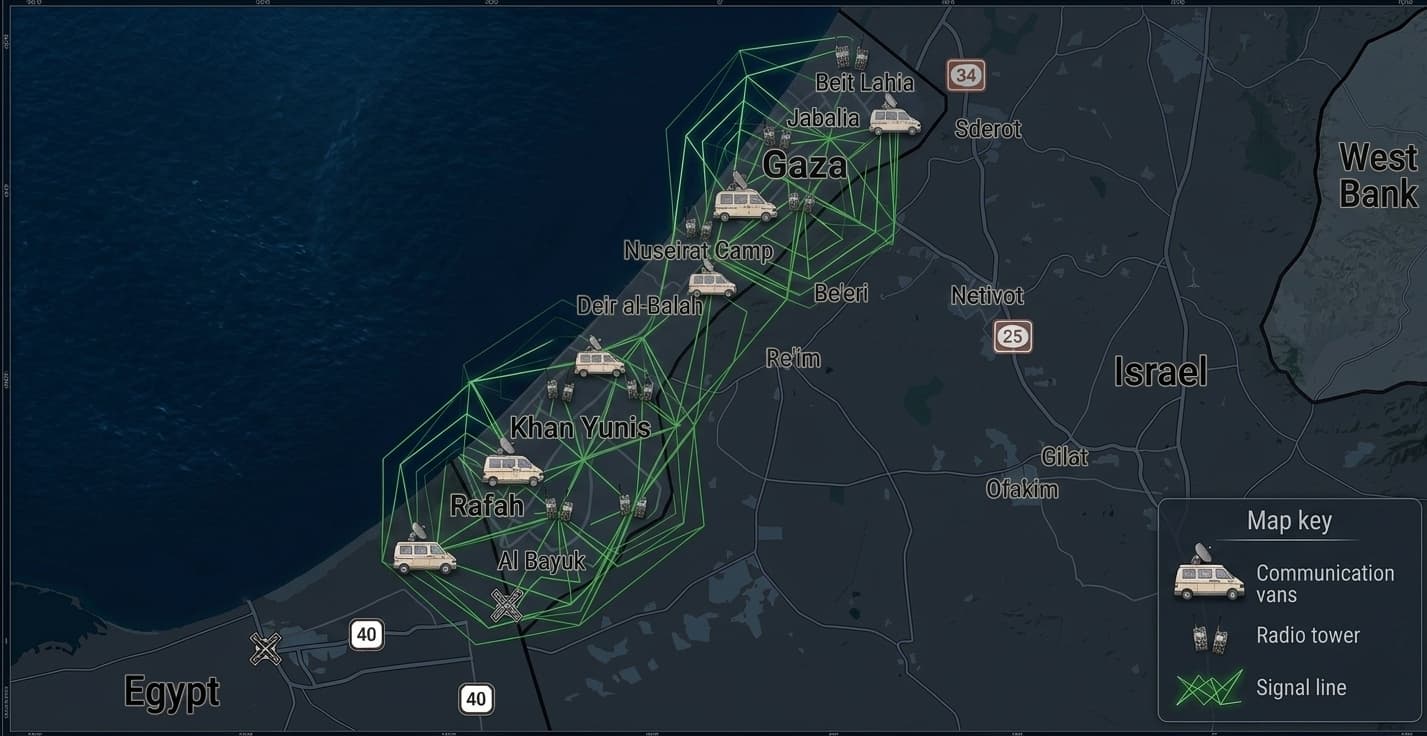
  • Cell 3: Van-Based Mesh Network. To solve the communication gap, mobile vans act as moving internet routers, bouncing signals to satellite gateways so volunteers can coordinate rescues without cell towers.

Phase 1: Factual Baseline

Damage Assessment & Human Rights Legal Audit

Damage Assessment Dashboard

Damage Assessment Overview (2000-2026)

Longitudinal structural loss, displacement, and service collapse extracted from the humanitarian report.

Factual baseline
Killed
Injured
90%
Displaced
Structures Damaged
Aug 2025
Famine Confirmed

Structural damage chart

198,273 affected structures

Damage mix

Share of affected stock
Destroyed123,464
Severe17,116
Moderate33,857
Possible23,836

Structural damage breakdown

Total: 198,273 structures
Destroyed123,464 structures
Severe17,116 structures
Moderate33,857 structures
Possible23,836 structures
Healthcare
  • 94% hospitals damaged
  • 50% partially functional
  • 46.5% primary care operational
Education
  • 97.5% schools damaged
  • 91.8% require reconstruction
  • 637k-658k children out of school

UDHR vs Islamic Law Matrix

Legal & Ethical Violations Matrix

A structured comparison of human-rights articles and Islamic legal principles against documented violations.

Animated row cards
72,315 killed172,137 injured1.9M displaced81% structures damagedFamine confirmed (Aug 2025)

Legal Snapshot

Animated counters

UDHR Articles Mapped

Islamic Principles

Population Displaced

Structures Damaged

Rights Stress Signals

High impact indicators
Civilian Protection Collapse96%
Healthcare System Stress94%
Education System Disruption98%
Movement Restriction Severity92%

UDHR Violations Matrix

Article, principle, source, and documented violation
Article 3
Right to Life
UDHR Article 3

72,315 killed and civilians repeatedly targeted across homes, hospitals, and displacement sites.

Article 5
Freedom from Inhuman Treatment
UDHR Article 5

Starvation conditions, water reduced to 3L/day in areas, and famine confirmed in Aug 2025.

Article 7
Equality Before Law
UDHR Article 7

International legal protections are unevenly enforced; accountability gap remains systemic.

Article 9
Forced Displacement
UDHR Article 9

1.9M people displaced, many repeatedly relocated multiple times under unsafe conditions.

Article 12
Right to Home
UDHR Article 12

81% of structures damaged and 320,622 housing units affected.

Article 13
Freedom of Movement
UDHR Article 13

Blockade, crossing closures, and internal mobility collapse due to damaged roads.

Article 14
Right to Seek Asylum
UDHR Article 14

Exit routes sealed; Rafah closure and naval blockade prevent asylum access.

Article 17
Right to Property
UDHR Article 17

198,273 structures destroyed/damaged including homes, hospitals, schools, and businesses.

Article 19
Freedom of Expression
UDHR Article 19

251 journalists killed, undermining information flow and independent reporting.

Article 25
Adequate Standard of Living
UDHR Article 25

Food supply below 5%, widespread service collapse, and severe healthcare degradation.

Article 26
Right to Education
UDHR Article 26

97.5% schools damaged and 637k-658k children out of formal learning.

Article 28
Right to a Just International Order
UDHR Article 28

Enforcement paralysis and persistent failure to implement protection measures.

Islamic Law Principles

Principle, source, and violation summary
Prohibition of killing civilians

Quran 6:151, 17:33; Hadith (Abu Dawud)

21,289+ children killed and civilian-heavy casualty profile (women, children, elderly).

Prohibition of starvation as a weapon

Quran 5:32; Muwatta Malik; Abu Dawud

Famine declared Aug 2025; food under 5% requirement and severe water deprivation.

Protection of hospitals and healing spaces

Al-Mawardi; al-Shaybani

94% of hospitals damaged and sustained targeting of medical infrastructure.

No collective punishment

Quran 6:164; 17:15

Population-wide siege effects on 2.3M civilians through food, fuel, medicine restrictions.

Humane treatment of vulnerable people

Quran 76:8-9

101,000 children at malnutrition risk and severe breakdown of care conditions.

Protection of orphans

Quran 93:9; Sahih al-Bukhari

19,000-39,000 children orphaned and 17,000 unaccompanied or separated minors.

Priority-Based Intervention Framework

Life-Saving vs. Life-Sustaining response framework aligned with urgency levels

P1Urgency Level

Immediate Rescue

Urgency

Extreme / Critical

Timeframe

0–72 hours

Focus

Preservation of human life through emergency healthcare, safe evacuation, and access to clean water.

Medical Corridors

  • 94% of hospitals damaged, only 18 partially functional (50%)
  • 172,137 people injured with overwhelming healthcare demand
  • Safe transport corridors critical for emergency aid delivery

Clean Water Access

  • 70% of water infrastructure damaged, 162 of 284 wells destroyed
  • Per capita availability: 3L/day (WHO minimum: 15L/day)
  • Deploy mobile desalination and emergency water trucking systems

Emergency Supplies

  • Food supply at <5% of required availability
  • 1.9M people (90% population) internally displaced
  • 77% in IPC Phase 3+ food insecurity with confirmed famine
Active Framework
P2Urgency Level

Rehabilitation

Urgency

High

Timeframe

3 days – 3 months

Focus

Restoring human well-being and psychological stability, especially among vulnerable populations.

Trauma Triage for Children

  • 19,000–39,000 orphaned children requiring immediate care
  • 17,000 unaccompanied or separated children
  • Widespread cases of WCNSF (Wounded Child, No Surviving Family)

Psychosocial Programs

  • Average 3-4 repeated displacements per person (up to 10 times for some)
  • Community counseling and peer support critical for trauma recovery
  • Early intervention reduces long-term mental health impacts by 30-40%

Education Continuity

  • 97.5% of schools damaged/destroyed
  • 637,000–658,000 children out of school for 2+ years
  • Temporary learning spaces essential for cognitive development
Active Framework
P3Urgency Level

Rebuilding

Urgency

Moderate to Low

Timeframe

3 months – years

Focus

Reconstruction of infrastructure and restoration of long-term socio-economic systems.

Infrastructure Restoration

  • 81% of all structures affected (198,273 structures)
  • 320,622 housing units damaged or destroyed
  • Water, electricity, and transportation systems require systemic reconstruction

School System Rehabilitation

  • 91.8% of schools require full reconstruction
  • All universities and higher education severely damaged
  • Education system at near-total collapse requiring major investment

Economic Recovery

  • Infrastructure collapse has disrupted all livelihoods
  • Restricted mobility and crossing constraints limit supply chains
  • Large-scale employment generation and reconstruction funding required
Active Framework

Framework Principle

Life-Saving vs. Life-Sustaining

Coverage

3 Priority Levels

Total Timeframe

0–72 hours β†’ Years

Phase 2: Economic Engine

Logistical Routing // Anticipation Pipeline // The 3 A's

[SYSTEM.LOGISTICS.ECONOMICS]

Total Physical Aid Drafted

MT

Capital Pledged (Liquid)

PKRBillion
1_Assessment [Physical]
2_Acquiring_Tech

Web3 Gateways

Bypassing SWIFT via USDC transfers on low-fee networks for instant global donor capital.

B2B CSR Hooks

API integration with corporate giving platforms for automated employee matching.

Transparency Ledger

Public dashboard verifying 100% of capital transfer to local ground workers directly.

3_Allocation_Pipeline

[SYSTEM.ASSET.TELEMETRY]

Fleet Core

Transport Modalities

  • Flights: 34 (100-ton capacity)
  • Marine Ships: 04 Commercial Freighters
  • Trucks: 73 Ground Transports
  • Land Routes: 02 Approved Arteries
Triage Assets

Medical Delivery

  • Tons of essential medicines & surgical supplies transferred to border triage staging zones.
  • Fully equipped border-adjacent triage ambulances active and operational.
Rehab

Psychosocial Support

  • Orphaned children actively receiving $50/month stipends via tracked digital transfers.
  • Fully operational pop-up tent schools established directly inside the conflict zone.
Cargo Typology Shift

Initial: Trauma kits & winterized shelter.

Current: Prioritizes MREs, dates & canned fruit.

Catalyst: Total collapse of power grid & absolute lack of potable water required to cook raw grains.

Ground Routing Networks

Saylani (SWT) & Baitussalam executing internal digital capital transfers to effortlessly bypass physical blockades.

Tele-Social Work Framework for Rescue Coordination

Vehicle-based mesh communication network enabling real-time humanitarian rescue operations, medical evacuations, and resource coordination without relying on destroyed infrastructure
⚠️

The Critical Problem

With 86% of physical humanitarian aid intercepted or looted before reaching civilians, and 1.9 million people displaced (90% of Gaza's population), traditional logistics has failed. Water availability in North Gaza stands at just 3 liters per person daily (WHO minimum: 15L). Famine was officially confirmed in August 2025.

The solution: Digital-first rescue coordination using vehicle-based mesh networks that bypass physical blockades and enable real-time triage, evacuation coordination, and resource distribution directly to affected communities.

⚠️

86%

Aid Interception Rate

πŸ’§

3L

Water per Person (North Gaza)

πŸ‘₯

1.9M

Internally Displaced

🀝

19K-39K

Orphaned Children

The 3R Model

🚨

RESCUE

Focus

Medical corridors, clean water, emergency food, shelter

Urgency

Extreme / Critical (0-72 hours)

Tele-Social Work Role

Real-time needs tracking, medical triage, evacuation alerts

πŸ’™

REHABILITATE

Focus

Trauma support for orphans, WCNSF children

Urgency

High (3 days - 3 months)

Tele-Social Work Role

Basic Psychological First Aid (PFA) AFTER survival stable

πŸ—οΈ

REBUILD

Focus

Infrastructure, schools, economy

Urgency

Moderate to Low (months - years)

Tele-Social Work Role

Data collection for future planning

6-Step Rescue Workflow

1

Identify Emergency

Local volunteer finds emergency (medical, water, food, shelter)

Uses handheld pager/radio connected to nearest van
2

Data Entry

Report entered via mobile app (offline-capable)

Categories: Medical / Water / Food / Shelter / Evacuation
3

Mesh Relay

Vehicle mesh network relays message

Self-healing routing: A→B→C or A→D→C if B is down
4

Border Gateway

Gateway node in Egypt receives message

Forwards to Pakistan via internet or Starlink satellite
5

Remote Triage

Remote coordinator (Pakistan) prioritizes response

Medical β†’ contact border corridor / Water/Food β†’ dispatch / Evacuation β†’ coordinate gates
6

Confirmation & Follow-up

Confirmation sent back via same path

Volunteer receives ETA of aid or evacuation instructions

Communication Architecture

🏘️ Volunteer

Field Team

πŸ“» Pager/Radio

Local Comms

🚐 Van Node

Mobile Hub

🌐 Mesh Network

Self-Healing

πŸ‡ͺπŸ‡¬ Egypt Gateway

Border Relay

πŸ›°οΈ Satellite/Internet

Pakistan Link

βœ… Response

Confirmation

βœ“

Self-Healing Mesh

Routes automatically reroute through available nodes when primary paths fail

βœ“

Infrastructure Independent

Functions without fixed telecom towers or centralized facilities

βœ“

Mobile-First Network

All nodes are vehicle-based, enabling dynamic topology adaptation

βœ“

Decentralized Coordination

No single point of failure - each vehicle operates independently

Operational Coverage Map

Operational Coverage Map

Train-the-Trainer Model

πŸ₯

Module 1

Emergency Triage

How to assess: Medical vs Water vs Food vs Shelter (0-72 hour window)

πŸ“Ή Pre-recorded videos | πŸŽ™οΈ Live mesh audio | πŸ“± Offline app

πŸ“±

Module 2

Needs Reporting

Using mobile app + pager/radio. Categories aligned with mesh network

πŸ“Ή Pre-recorded videos | πŸŽ™οΈ Live mesh audio | πŸ“± Offline app

πŸš—

Module 3

Evacuation Coordination

Safe routes to Rafah, Zikim (reopened April 13, 2026), Kerem Shalom

πŸ“Ή Pre-recorded videos | πŸŽ™οΈ Live mesh audio | πŸ“± Offline app

πŸ‘§

Module 4

WCNSF Child Handling

Identify Wounded Child No Surviving Family (19,000-39,000 orphans)

πŸ“Ή Pre-recorded videos | πŸŽ™οΈ Live mesh audio | πŸ“± Offline app

πŸ’»

Module 5

86% Interception Bypass

Digital reporting instead of physical convoys. Direct financial transfers

πŸ“Ή Pre-recorded videos | πŸŽ™οΈ Live mesh audio | πŸ“± Offline app

🧠

Module 6

Volunteer Self-Care

Burnout prevention in active war zone. Peer support via mesh network

πŸ“Ή Pre-recorded videos | πŸŽ™οΈ Live mesh audio | πŸ“± Offline app

Delivery Methods: Pre-recorded videos (offline), live mesh network audio calls (weekly coordination), searchable digital handbook in app, peer-to-peer training via mesh network

πŸ“‹ Real-World Scenario: WCNSF Child

Background

A WCNSF child (Wounded Child, No Surviving Family) – 9-year-old, lost entire family in airstrike, leg wound infected and untreated for 5 days, hiding in rubble in North Gaza with only 3 liters of water available daily.

1

Volunteer (trained teacher) finds child during food distribution. Uses handheld pager β†’ nearest van

2

Reports via mobile app (offline): 'WCNSF child, leg wound infected, no surviving family, location North Gaza'

3

Vehicle mesh network relays message. Self-healing routing A→B→C to Egypt gateway (86% physical aid interception bypassed via digital reporting)

4

Remote coordinator (Pakistan) triages as RESCUE – Medical

5

Coordinator contacts medical corridor at Zikim Crossing (reopened April 13, 2026). Evacuation coordinated

6

Child evacuated within 48 hours. Wound treated. Infection controlled. Survival secured

7

ONLY AFTER rescue β†’ Child added to tele-psychiatry waitlist for trauma counseling (Rehabilitation phase)

βœ“ Outcome:

Child survives. Receives immediate physical rescue and medical care, then transitions to psychological support in the Rehabilitation phase. All through a decentralized, mesh-networked system that bypasses the 86% physical aid interception rate.

Tele-Psychiatry Integration (Rehabilitation Phase)

πŸŽ™οΈ

Audio Calls (Primary)

Low bandwidth, works via mesh network. 80% of sessions

πŸ“Ή

Video Calls (When Available)

For diagnostic assessment. Requires better connection

πŸ’¬

Text via Pager System

Check-ins, appointment reminders, crisis messages

This ensures continuity of care AFTER physical survival is secured – aligning with the 3R model and prioritizing rescue over rehabilitation

Framework Capabilities

πŸ›‘οΈ

Bypasses 86% Aid Interception

Digital needs reporting instead of physical convoys that get looted

πŸ“‘

Works Without Internet

Vehicle mesh network + handheld pagers ensure functionality in all conditions

🚨

Prioritizes Rescue Correctly

Medical/water/food/evacuation BEFORE counseling or rehabilitation

πŸ“ˆ

Scales to 1.9M Displaced

970 displacement sites covered via van-based mesh network

πŸ‘§

Supports WCNSF Children

Identification β†’ evacuation β†’ later rehabilitation (19,000-39,000 orphans)

πŸ’³

Enables Digital Bypass

Direct financial transfers to local workers (Plan B) bypassing physical barriers

This Tele-Social Work Framework for Rescue Coordination makes rescue-phase psychosocial coordination possible in Gaza despite physical access limitations – aligning with humanitarian mandates while maximizing operational efficiency through decentralized, mesh-networked infrastructure.

Biestek's 7 Principles as a Digital Field Framework

A short field guide that turns casework ethics into QR profiles, scripts, expression tools, therapist escalation, and privacy controls.

7
Principles

Biestek ethics mapped to shelter workflows

24/7
Field Scripts

Crisis prompts available for volunteers

Hybrid
Care Model

Local support with remote therapist relay

Shelter Workflow

A simple response path for volunteers working under pressure.

01

Assess

Scan child profile and review trauma-safe guidance.

02

Respond

Use calm scripts, choices, and expression tools.

03

Protect

Keep case details private with role-based access.

04

Continue

Offline-first records keep service moving in low connectivity.

Principle Library

Compact field cards

7 principles
01

Individualization

Issue: In crowded Gaza shelters, workers naturally see a crowd rather than individuals.

Digital action: Digital Case File System with QR identification.

individualized and safer communication.

02

Purposeful Expression of Feelings

Issue: Children often have no private space to speak inside damaged shelters.

Digital action: Green Zone geofencing with digital expression tools.

trauma expression without pressure.

03

Controlled Emotional Involvement

Issue: Local volunteers are also traumatized and can become overwhelmed.

Digital action: Remote therapist relay and emotional check-in prompts.

continuity of care without burnout.

04

Acceptance

Issue: Regressive behavior can frustrate exhausted workers.

Digital action: Behavioral normalization prompts.

support replaces punishment.

05

Non-Judgmental Attitude

Issue: Aggression can trigger punitive reactions in crisis shelters.

Digital action: Crisis Mode script shield.

de-escalation without shame.

06

Client Self-Determination

Issue: Crisis settings often default to total worker control.

Digital action: A/B choice interface.

restored control in a high-loss environment.

07

Confidentiality

Issue: Multi-volunteer environments can leak sensitive details.

Digital action: Encrypted case files with access controls and audit logs.

privacy and ethical continuity.

Action Map

Principles to volunteer decisions

Quick field mapping
PrincipleTech SolutionVolunteer Action
IndividualizationQR Code + Digital Case FileScan ID and follow custom prompt
Purposeful ExpressionGreen Zone + Drawing ToolGuide child to draw/play
Controlled Emotional InvolvementRemote Therapist RelayEscalate when overwhelmed
AcceptanceBehavioral Normalization PromptsUse normalization scripts
Non-Judgmental AttitudeCrisis Mode + Script ShieldUse non-judgmental script
Client Self-DeterminationChoice Interface (A/B)Offer options and honor choice
ConfidentialityEncrypted Files + Access LogsAvoid verbal case disclosure
Deployment Stack

Technical requirements

The technology layer is intentionally practical: rugged devices, offline continuity, encrypted records, and short training cycles for emergency field teams.

Mobile Device
Ruggedized Android smartphones (5,000 units)
App Features
QR scanner, drawing tool, sandtray simulator, script library, escalation button
Encryption
AES-256 for all stored and transmitted data
Connectivity
Offline-first mesh network + satellite backhaul for escalations
Training
4-hour module: Biestek principles + app usage